

.svg)
.svg)
.svg)
.avif)
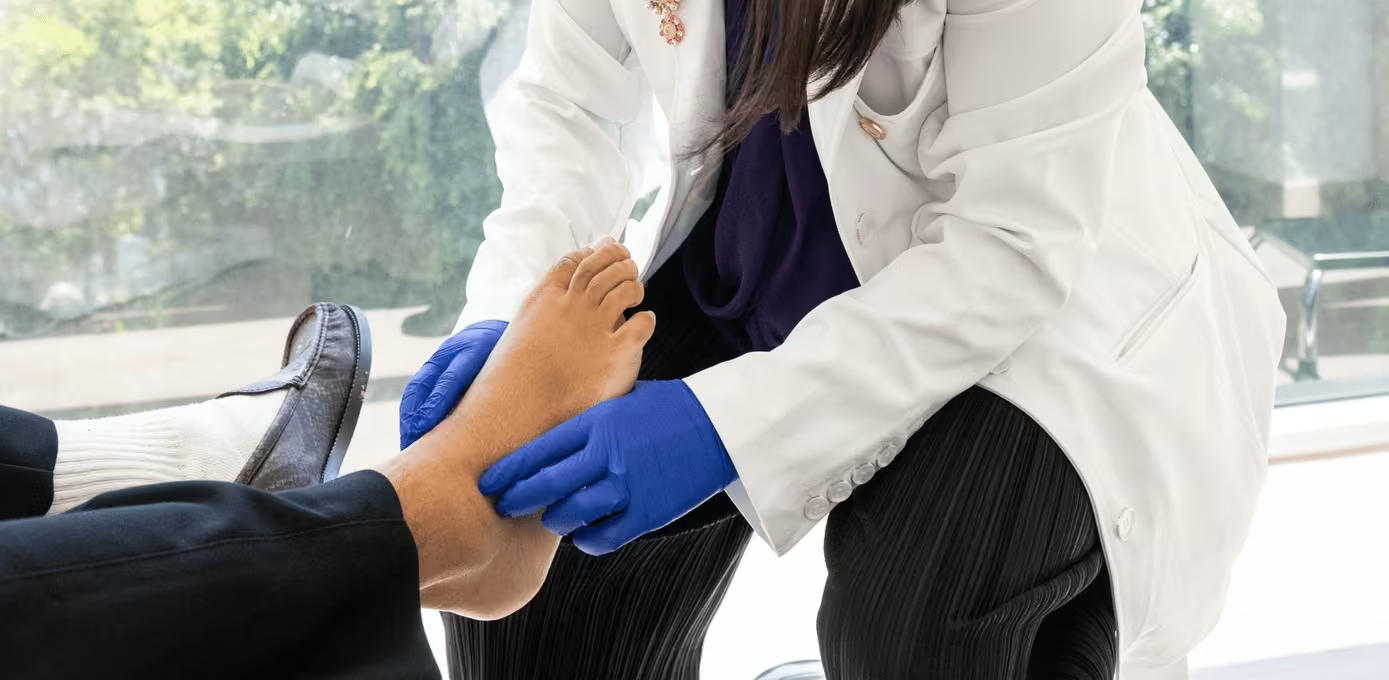
Nearly everyone sprains an ankle at some point, but nearly 40% of people who sustain a lateral ankle sprain go on to develop chronic ankle instability. This medical term for an ankle that repeatedly rolls can cause repeated ankle sprains and weak ankles that can interfere with your hobbies, exercise routines, and even your job.
Continue reading to learn why repeat ankle sprains keep happening, why physical therapy can’t always fix it, and where to find the best ankle surgeon in Los Angeles for permanent treatment.
Why Does My Ankle Keep Rolling? Understanding Chronic Ankle Instability
On the outside of your ankle sit two small bands of tissue called the anterior talofibular ligament (ATFL) and the calcaneofibular ligament (CFL). Picture these ligaments as support straps that keep your ankle joint lined up every time you take a step. Each ankle sprain stretches and frays those straps a little more, and after enough injuries, they heal in a loose, lengthened position, like a rubber band that has been pulled too many times. That looseness has no way to re-tighten on its own. Once those straps stop holding the joint steady, the ankle keeps giving way.
People with chronic lateral ankle instability often feel the joint buckle on flat ground, on stairs, or while turning to reach for something on a shelf. Additionally, the ankle can feel wobbly or untrustworthy, and swelling sometimes returns for no clear reason.
What Are the Ligaments of the Ankle?
The outside of the ankle is held together mainly by two ligaments. The anterior talofibular ligament, or ATFL, runs along the front of the outer ankle. The calcaneofibular ligament, or CFL, sits just below it. Together, they act like support straps that keep the ankle bones lined up when you walk, run, or land from a jump. A single sprain can stretch these straps and tear some of their fibers. When you sprain the same ankle repeatedly, the damage builds.
Why Isn't Physical Therapy Working for My Ankle?
Physical therapy strengthens the muscles around the ankle and is the right first step after an ankle sprain. Good therapy builds the muscles around the joint, sharpens your balance, and helps most people return to full activity after a sprain. But even with the best physical therapy, there is no way to shorten a ligament that has already stretched out. So even if you follow the program closely for months, your ankle could keep giving way.
When is Ankle Surgery Actually Necessary?
Ankle surgery is usually recommended after conservative care has had a fair chance to work. For most patients, that means a few months of structured physical therapy along with bracing or taping to steady the joint during activity. When those efforts fail to restore stability, surgery becomes the best option.
There are a few signs that suggest the ankle has reached this point:
- The ankle joint keeps giving way during everyday movement
- Ankle sprains keep happening even with a brace on
- Ankle instability holds you back at work, in sports, or during simple daily tasks
Even with these symptoms, the only way to know for sure if ankle surgery is right for you is to have the best foot and ankle surgeon in Los Angeles examine the ligaments and order imaging to confirm they have stretched beyond repair.
The Broström Procedure: A Minimally Invasive Procedure to Stabilize the Ankle
The most common operation for chronic lateral ankle instability is the modified Broström procedure. During the surgery, the best foot surgeon in Los Angeles tightens the stretched ATFL and the CFL, then reattaches and reinforces these ligaments to rebuild the ankle's normal anatomy. The repair restores tension to the support straps that wore out over years of repeated sprains, which gives the joint back the steadiness it lost.
Considered the best ankle sprain treatment in Los Angeles, surgeons favor this kind of anatomic repair because it recreates the ankle's natural biomechanics and the original course of the worn ligaments. This procedure is considered minimally invasive and can be performed through a small incision.
The Broström Procedure Recovery Timeline
Recovering from a Broström repair is quick and easy for most patients:
- For the first couple of weeks, the ankle stays protected in a splint or boot while the repair settles.
- Two to four weeks after surgery, patients move into a walking boot and slowly add weight to the foot. Physical therapy also resumes around this time to rebuild strength and mobility. Regenerative therapies can also begin at this time to help accelerate recovery.
- Two to three months after surgery, most people return to low-impact activity, and a full return to sports often falls somewhere around the four to six-month mark, depending on the demands of the sport.
The results of ligament reconstruction depend heavily on the surgeon's skill, so choosing a fellowship-trained foot and ankle surgeon who has completed extra subspecialty training focused on these exact procedures offers a significant advantage.
Finding the Best Ankle Surgeon in Los Angeles for Treatment of Chronic Ankle Instability
If your ankle has buckled one too many times and you’re searching for the best ankle sprain treatment in Los Angeles, Dr. Megan Ishibashi offers comprehensive podiatry and expert surgical care, from bracing to the minimally invasive Broström repair.
As a fellowship-trained foot and ankle surgeon who founded KIN Foot & Ankle around precise, individualized care, Dr. Ishibashi served as Chief Resident at the Kaiser San Francisco Bay Area Foot & Ankle Residency Program and completed the Silicon Valley Foot and Ankle Reconstruction Fellowship at the Palo Alto Medical Foundation, with focused training in sports medicine, arthroscopy, minimally invasive surgery, and ligament reconstruction. Additionally, she’s a nationally and internationally ranked judo athlete who understands what recovery and a real return to sport ask of your body.
Ready to get effective treatment for chronic ankle instability from the best ankle surgeon in Los Angeles?


.svg)
.svg)
.svg)
