

.svg)
.svg)
.svg)
.avif)
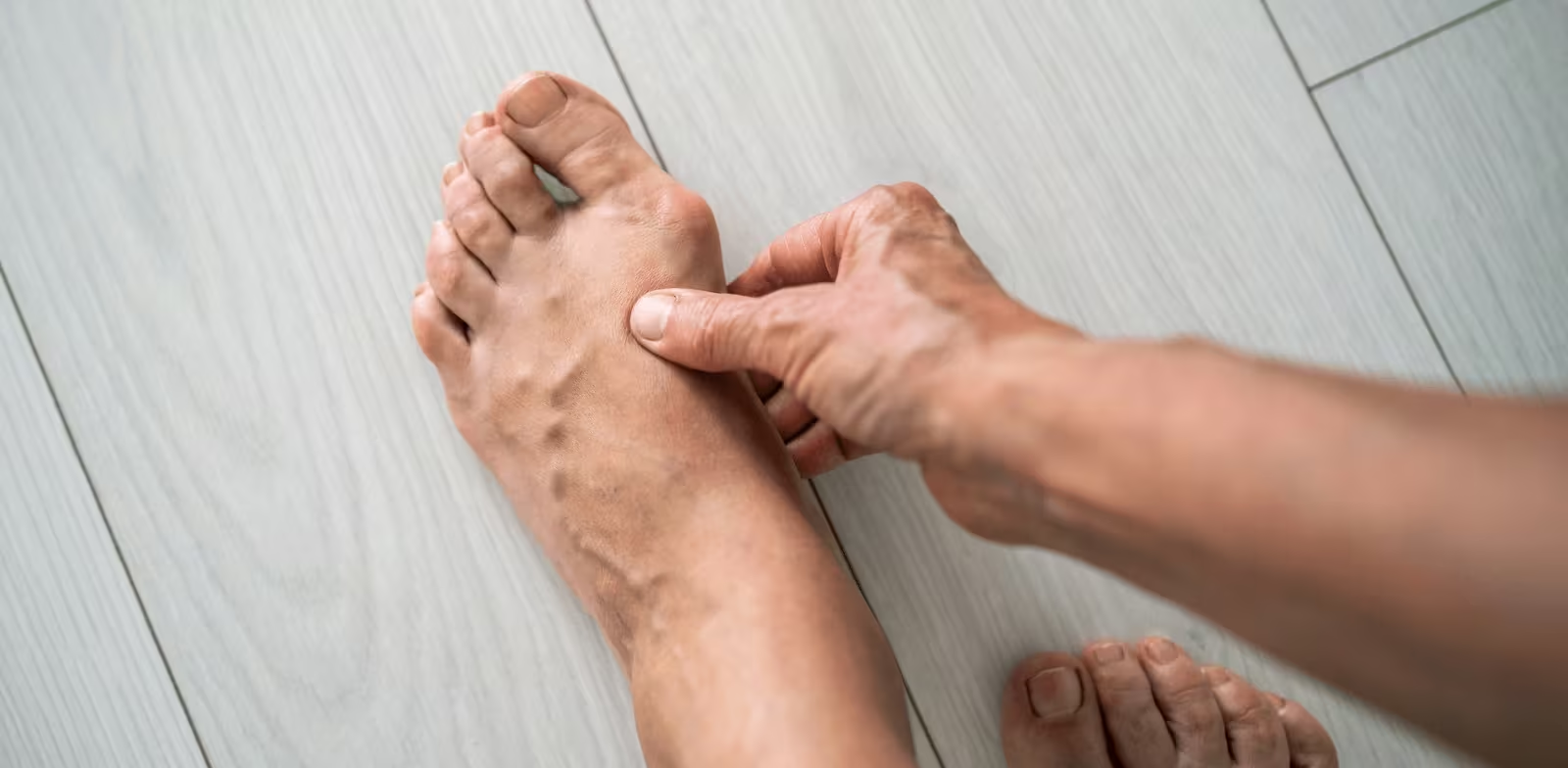
Bunions, also known as hallux valgus, affect roughly 23% of adults aged 18 to 65 and 35.7% of adults over 65, with women affected at more than twice the rate of men. While most people turn to home remedies for bunions, like wearing shoes with a wide toe box, getting custom orthotics, or using toe spacers, these tools only provide short-term relief and can’t actually cure a bunion the way bunion surgery does.
For those with severe bunions that interfere with walking and standing, bunion surgery is the only way to get lasting relief. Finding a foot surgeon who offers minimally invasive bunion surgery and preparing for surgery and recovery is the first step in this process.
Read on to learn what minimally invasive bunion surgery involves, how it compares to traditional bunion surgery, and where to find the best foot surgeon in Los Angeles for bunion surgery.
Types of Bunion Surgery
A bunion correction surgery involves cutting the affected bone, shifting it back into its proper position, and holding it there while it heals. The best minimally invasive foot surgery in Los Angeles for bunions is a third-generation MIS, which uses precise bone cuts, two or three titanium screws for fixation, and protocols that allow early walking.
What is Minimally Invasive Bunion Surgery?
In a traditional bunion removal surgery, the surgeon makes a single incision two to three inches long down the side of your big toe, peels back the skin and soft tissue, and reshapes the bone in plain view. With a minimally invasive approach, the best foot surgeon in Los Angeles works through incisions roughly three to five millimeters wide, about the diameter of a pencil eraser, using a high-speed rotating burr to cut and reposition the bone. A live X-ray called fluoroscopy lets the surgeon see exactly where the bone is moving during the procedure, and small titanium screws hold everything in the corrected position while you heal.
The smaller openings mean less disruption to the tendons, ligaments, and small nerves that run along the side of your foot. That matters because most of the swelling, bruising, and post-surgical pain after a traditional bunion correction comes from the soft tissue trauma, not the bone work itself. When the soft tissue is left mostly alone, recovery is faster and less painful.
Can Severe Bunions Still be Treated with Minimally Invasive Surgery?
Reviewing your weight-bearing X-ray images is the only way to know if minimally invasive surgery is right for you. These images show two key measurements:
- The hallux valgus angle, or how far your big toe has tilted toward the second toe
- The intermetatarsal angle, or how far the bones in your forefoot have spread apart
Mild and moderate bunions are often strong candidates for minimally invasive correction, because the bone shift required falls comfortably within what the MIS technique can do. Severe bunions, or bunions tied to a loose joint at the midfoot, sometimes need a Lapidus procedure or a more traditional open approach to get a stable, lasting result.
Recovering from Bunion Surgery
With traditional open surgery, most patients spend two to six weeks completely off the foot that was operated on. During this time, relying on a knee scooter or crutches is necessary. With third-generation MIS, most patients are walking in a protective surgical shoe the same day or the next day. That early movement helps reduce stiffness in the joint and supports better long-term function.
After MIS bunion surgery, many patients are back in a wide athletic sneaker around six to eight weeks, in dress shoes by ten to twelve weeks, and back to running, hiking, or pivoting sports between three and four months. Traditional open surgery often pushes those same milestones out to a four to six-month total recovery.
Is Minimally Invasive Bunion Surgery Right for You?
Strong candidates for minimally invasive bunion surgery usually have:
- Mild to moderate deformity
- A flexible big toe joint
- Minimal arthritis at the joint surface
The best bunion surgeon in Los Angeles will also want to identify where the deformity originates. If the issue is primarily at the head of the metatarsal, minimally invasive bunion surgery works well. If the unstable point is further back at the midfoot, where the first metatarsal meets the bones of the arch, an open procedure may give a more durable result.
Your overall health also matters. Smoking slows bone healing significantly and can compromise the outcome of any bunion surgery. Diabetes, especially when blood sugar is not well controlled, also raises infection risk and slows recovery. Low bone density, peripheral artery disease, and chronic steroid use all factor in as well. Choosing the best foot surgeon in Los Angeles is the best way to know you’re getting the most appropriate treatment.
Where to Find the Best Foot Surgeon in Los Angeles for Bunions
Choosing a surgeon for your bunion correction is the first step in ensuring you get the best care and lasting relief, and for those in Los Angeles, Dr. Ishibashi is the clear choice. As a fellowship-trained foot and ankle surgeon who performs minimally invasive bunion surgery using the third-generation technique, Dr. Ishibashi is known as the best foot and ankle surgeon in Los Angeles.
We built our clinic around the kind of experience we would want for ourselves: state-of-the-art imaging and surgical equipment, and a treatment and recovery plan built around your needs.
Ready to get lasting relief from bunion pain with help from the best foot surgeon in Los Angeles?

.svg)
.svg)
.svg)
